
Are We Actually More Educated?: Education Levels in the Americas
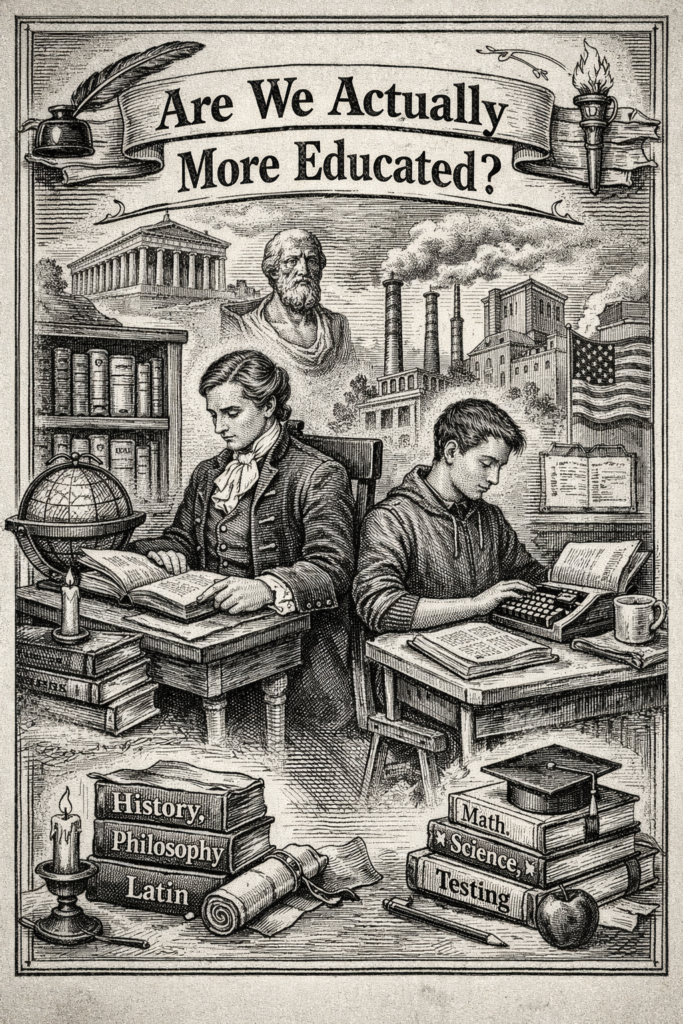
We often say that we are the most educated and literate generation in American history. By most modern measurements, that is true. Literacy rates are high, high school completion is widespread, and college attendance is common. Compared to earlier centuries, access to education has expanded dramatically.
But I am not fully convinced that this means we are more educated in the deeper sense.
It depends on what we mean by education.
When I look back at the founding generation—figures like Alexander Hamilton and Thomas Jefferson—I see something that feels fundamentally different. Their writing is precise, structured, and intellectually dense. It assumes familiarity with history, philosophy, classical antiquity, and Scripture. Hamilton, writing in the Federalist Papers, moves seamlessly between political theory, historical examples, and logical argumentation in a way that is rarely encountered in modern public writing. Jefferson, in both public and private correspondence, draws on classical authors, Enlightenment philosophy, and legal reasoning with a fluency that suggests not just education, but immersion in a tradition.
This was not accidental. It was the product of a specific kind of education that was common among the educated class in the 18th century.
Colonial American schooling, especially in grammar schools and early colleges, was heavily rooted in the classical model. Students studied Latin and often Greek from a young age. They read authors such as Cicero, Virgil, Homer, and Xenophon. They memorized passages, translated texts, and practiced rhetoric as a formal discipline. Harvard’s early curriculum, for example, required students to read classical texts and demonstrate proficiency in Latin as a condition of admission and advancement. The purpose of this education was not simply literacy, but the formation of judgment, taste, and the ability to argue and persuade.
This model itself traced back to the older European tradition of the trivium—grammar, logic, and rhetoric—which defined education as the training of the mind, not merely the acquisition of information.
Even earlier, thinkers like John Milton articulated an expansive vision of education. In Of Education (1644), Milton argued that true education should prepare a person “to perform justly, skillfully, and magnanimously all the offices, both private and public, of peace and war.” This definition assumes that education is not just technical training, but moral, intellectual, and practical formation.
By contrast, the structure of modern public education took shape during and after industrialization, particularly in the 19th century. As schooling expanded to serve a much larger population, its purpose shifted. The emphasis moved toward standardization, basic literacy, numeracy, and the preparation of individuals for participation in an industrial economy. Horace Mann and other reformers successfully built a system that made education broadly accessible, which was a major achievement. But the scale of that system required simplification. The classical model—labor-intensive, language-heavy, and oriented toward a smaller elite—was gradually reduced in favor of more uniform curricula.
The result is that modern education excels at breadth but often lacks depth in foundational areas. Most students today are not trained in Latin or Greek. Few read classical texts in their original form. Memorization, once central to education, is largely absent. Rhetoric, as a formal discipline, is rarely taught in a sustained way. Writing is often shorter, more functional, and less structured than in earlier periods.
This does not mean modern people are less intelligent. It does mean that the kind of intellectual formation they receive is different.
In many ways, we are more informed than any previous generation. Information is abundant and accessible. Specialized knowledge is highly developed. But there is a difference between access to information and familiarity with a tradition of thought. Earlier educated individuals were expected to situate their thinking within a historical and philosophical lineage. Their writing reflects that expectation. Modern education, by contrast, often emphasizes immediacy—current knowledge, current skills, current application—without the same depth of historical continuity.
This difference becomes visible in language. The vocabulary used in earlier writings is often broader and more precise. Sentence structures are more complex. Arguments are developed over longer stretches. This is not simply stylistic preference; it reflects training. When students spend years translating classical texts and practicing rhetoric, their ability to express complex ideas increases accordingly.
There are also smaller, symbolic differences. Handwriting, once taught carefully as a discipline, has largely disappeared. Long-form memorization is rare. Public speaking, outside of specific tracks, is not deeply emphasized. These may seem minor, but they point to a broader shift away from education as formation and toward education as function.
None of this is to suggest that the past was universally superior. Earlier systems excluded large portions of the population and often lacked the inclusivity and scale of modern education. The expansion of access is one of the great achievements of modern society.
But the tradeoff is real.
We are clearly more schooled than any generation before us. We spend more years in formal education, earn more credentials, and have greater access to knowledge. But it is less clear that we are more deeply educated in the classical sense—formed in language, history, philosophy, and the disciplined expression of ideas.
This leads to a more precise question: are we more educated, or are we simply more credentialed?
The answer is likely both, depending on what we value. Modern education has expanded opportunity and developed technical expertise on an unprecedented scale. At the same time, it may have lost some of the depth and continuity that characterized earlier intellectual traditions.
If education is defined as the ability to read, write, and participate in an advanced economy, then we are undoubtedly the most educated generation in history. But if education is understood as the formation of the mind through deep engagement with language, history, and philosophy, then the answer becomes less certain.
That is the tension.
We have more access than ever before, but access is not the same as formation. And formation—the shaping of how a person thinks, speaks, and understands the world—may be the more demanding and more meaningful measure of education.
Leave a Reply