
The Fence:
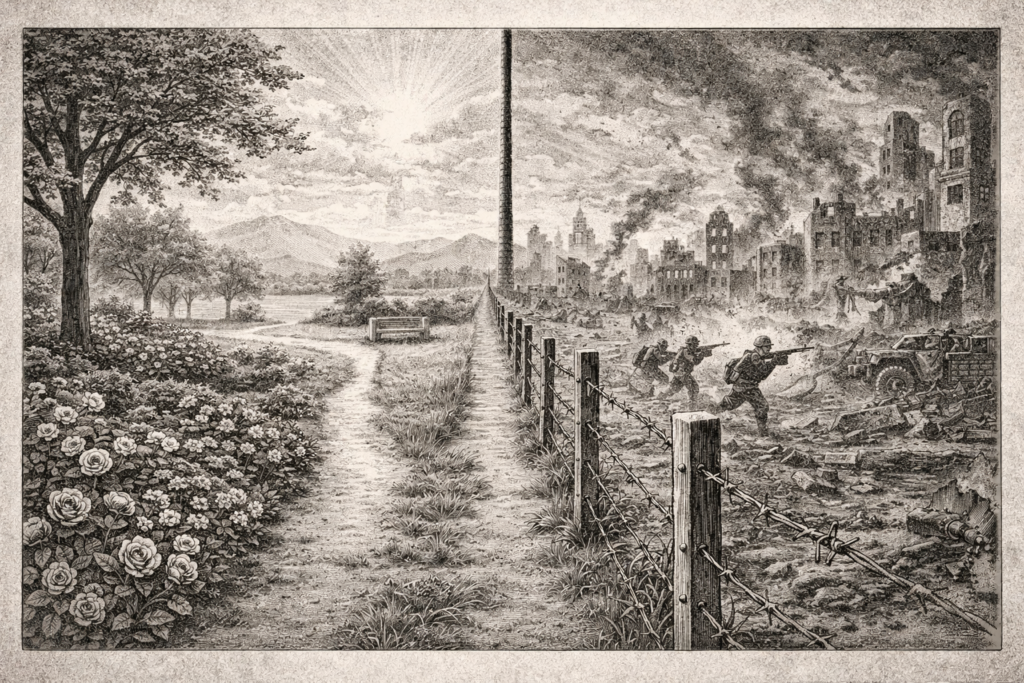
On hiding behind indecision, the modern myth of passion, and the call to move forward like a man.
I have a confession to make, and I suspect some of you will recognize yourselves in it.
For stretches of my life — longer than I would like to admit — I have lived in a state of intentional undecidedness. Not because I genuinely could not figure out what to do, but because not choosing felt safer than choosing wrong. If I never committed to a direction, I could never fail at it. I could keep the dream alive in theory, untested and therefore unspoiled, while telling myself — and anyone who asked — that I was still figuring it out. Still searching. Still discerning.
It felt humble. It felt open-minded. It felt, in a way, almost spiritual — like I was waiting on God rather than running ahead of Him.
But if I am honest, most of the time it was none of those things. It was fear dressed up in patient clothing.
The Fence Is Not Neutral Ground
I heard a sermon once — the kind that stays with you because it names something you already knew but had been carefully avoiding. The preacher said something I have not forgotten:
“The fence is the devil’s.”
He was preaching on Revelation 3, the letter to the church at Laodicea — the church that was neither hot nor cold, and which God said He would spit out of His mouth. The most nauseating thing to God in that passage is not wickedness. It is lukewarmness. The middle. The hedge. The man who has not chosen.
We tend to think of indecision as a morally neutral state — a pause between two options, neither good nor bad. But Scripture does not treat it that way. Living on the fence is not the absence of a choice. It is a choice — a choice for comfort, for self-protection, for the preservation of a self-image that has never been tested against reality. And that choice has consequences.
As I have seen in my own life: the man who refuses to commit to anything in particular rarely becomes excellent at anything in particular. He stays busy, stays engaged, stays interesting at dinner parties — but beneath the motion there is a kind of stagnation, a life lived in draft mode, always preparing and never publishing.
The Modern Myth of Passion
Here is where I think the culture has handed us a very convenient excuse: the idea that before you commit to a direction, you must first find your passion. Discover your calling. Identify the one thing that sets your soul on fire. And until that mystical revelation arrives, you are not really obligated to get moving — you are, by definition, still searching.
This is an almost entirely modern idea, and it does not hold up well historically.
For most of human history, people did not have the luxury — or the burden — of asking “what is my passion?” They asked: what needs to be done, and am I the one to do it? They farmed, built, made, raised, served. They found meaning not by locating a pre-existing passion and then building a life around it, but by bringing themselves fully to the work in front of them and discovering meaning in the doing.
The Bible does speak of spiritual gifts — genuine, God-given capacities that differ from person to person. But read carefully: these gifts are oriented toward the body of Christ, toward service and edification, not toward personal career fulfillment. The New Testament does not promise you a vocation that feels tailor-made. It promises you a God who can be glorified in whatever you put your hands to.
Paul, in fact, had sharp words for those who used spiritual searching as a cover for not pulling their weight. Writing to the Thessalonians about members of the church who had stopped working — perhaps in expectation of Christ’s imminent return, perhaps simply in avoidance — he did not treat them gently:
“If anyone is not willing to work, let him not eat.” — 2 Thessalonians 3:10
And in his first letter to Timothy, he went further, saying that anyone who does not provide for his own household has denied the faith and is worse than an unbeliever.
These are not the words of a man who thought that waiting around for clarity was a righteous posture. Paul worked with his hands as a tentmaker while planting churches. He did not wait until he had fully processed his calling before he got moving.
The Self-Deception of “Still Figuring It Out”
I want to be careful here, because I am not saying that prayer and discernment are wrong. They are not. I am not saying that patience is a vice. It is not. There are seasons where God genuinely calls us to wait — and that waiting is active, not passive.
What I am saying is that I have used the language of discernment to avoid the discomfort of commitment. I have baptized my fear in spiritual vocabulary and called it wisdom. I have told myself I was waiting on God when really I was waiting for a guarantee — waiting for assurance that if I stepped out, I would not fall.
That guarantee does not come. It never has. Faith, by definition, moves before it sees.
And here is the strange freedom I have found in accepting that: it is often better to choose the wrong thing courageously than to choose nothing at all from fear. A man who commits to a direction and fails has learned something real. He has grown. He has lived. He can repent, adjust, and move again. A man who never commits has learned nothing — he has only preserved a version of himself that was never tested and therefore never truly known.
The undecided life is not a life in waiting. It is a life in hiding.
Choose. Move Forward. Trust God With the Results.
So this is what I am preaching to myself, and what I offer to you if it is useful:
The state of not choosing is not a virtue. It is a modern lie — comfortable, socially acceptable, and spiritually dangerous. The fence is not neutral ground. The fence belongs to the enemy.
Just choose. Move forward like a man. Not recklessly — prayerfully. Not arrogantly — humbly, open to correction. But move. With confidence. With vigor. With the courage that comes not from certainty about the outcome, but from trust in the God who holds the outcome.
Take aggressive action. Prayerful action. Faithful, courageous action.
And if you choose wrong, God is big enough to redirect you. Scripture is full of men who moved in imperfect directions and were used anyway — because they were moving, and a moving vessel is far easier to steer than a stationary one.
Lord, forgive me for hiding behind undecidedness. Forgive me for calling fear by the name of patience, and laziness by the name of discernment. Give me the courage to choose — to step off the fence and move toward You with everything I have. I do not need a guarantee. I need You. So I choose. I move forward. I trust You with what comes next. Amen.
—
Scripture referenced in this post:
Revelation 3:15–16 | 2 Thessalonians 3:10 | 1 Timothy 5:8 | Ephesians 5:15–16
Leave a Reply