
The Richest Age of Mankind: What is true Wealth?
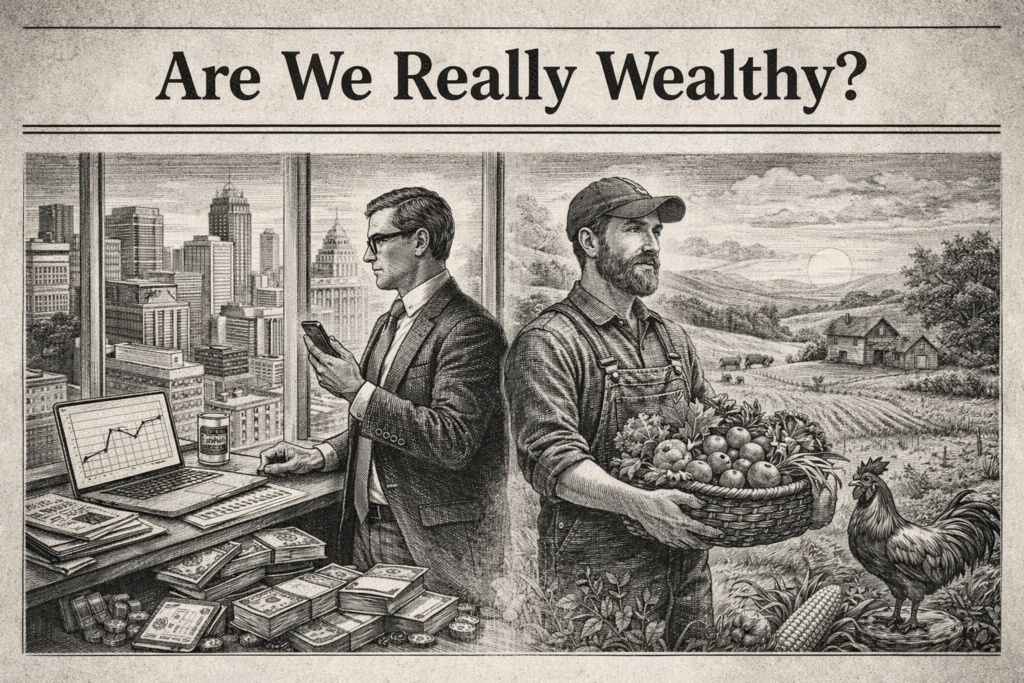
We are often told that we are the wealthiest humans who have ever lived.
In one sense, that is true. We have modern comforts, abundant food, medicine, entertainment, climate control, and conveniences that would have seemed extraordinary in almost any earlier age.
And yet many people do not feel wealthy.
That tension is worth paying attention to, because comfort is not the same thing as wealth. Access is not the same thing as abundance.
Our age tends to define wealth through money, consumption, and convenience. If you can afford things, upgrade things, and access things, you are considered wealthy. But older ages often understood wealth differently. Wealth was land, food, animals, tools, household strength, and useful skill. Wealth was the ability to produce, provide, protect, and pass something on.
That older definition still makes sense to me.
When I think of Jacob in the Bible, I think of a truly wealthy man. Scripture describes him increasing greatly, with large flocks, servants, camels, and donkeys. That is not modern financial language, but it is clearly real wealth: productive, tangible, living wealth. It fed a household. It filled land. It carried into the future.
Even today, that kind of wealth would still be recognizable. Land alone is worth enormous amounts. In places like California, even a single acre can be worth a fortune. But beyond price, land represents something deeper. It represents rootedness, stewardship, and a direct relationship with reality.
That is where the modern claim begins to feel thin.
We live in what is called the wealthiest society in history, and still the average hardworking person may never own land at all. They may earn steadily, work honestly, and still only rent space rather than possess anything substantial. They may have access to abundance without actually controlling it.
That is a different kind of life.
I think that is one reason many people struggle to feel wealthy even while being told constantly that they are. Much of what we call wealth today is really access to systems. We do not own abundance in the old sense. We rent proximity to it. We have grocery stores full of food, but very few people know how to grow it. We have endless products, but fewer people know how to build, repair, or make anything with their hands. We have comfort, but not always competence.
We have also lost space.
Many people live with very little physical space away from others. Cities are dense. Housing is compressed. Privacy is limited. Even small decisions about what to build or how to live often run into layers of regulation and red tape. There is little room to think, little room to build, and little room to be left alone.
That raises a serious question: is that really wealth? Is that really freedom?
Because space matters. Solitude matters. The freedom to shape your environment matters. A person with even a small amount of land possesses something that is becoming rare: quiet, autonomy, and room to live.
A person with land, useful skills, a garden, animals, craftsmanship, and the ability to provide for others has a kind of wealth that modern financial language does not fully capture. That life may not look glamorous, but it contains a kind of abundance many modern people quietly long for.
Honestly, I can’t help but feel like some hillbilly in Alabama might make a million dollars less than a man in New York and still have lived a more fulfilling and worthwhile life. Not because money does not matter, but because fulfillment seems to come from something deeper than income. It comes from place, purpose, competence, and participation in real life.
This is why I question the easy claim that we are simply the wealthiest people who have ever lived.
We may be the most comfortable.
We may be the most entertained.
We may be the most technologically advanced.
But that does not mean we are the most wealthy in the fullest sense.
Because what is wealth really?
Is it just access to abundance, or is it the ability to provide for and protect the people you love? Is it just money in accounts, or is it land, food, skill, and a life that can actually bear weight?
I think real wealth has to include more than comfort. It has to include substance. It has to include rootedness. It has to include the ability to live in a way that feels connected to what is real.
The most comfortable society does not necessarily equate to the most wealthy.
And maybe that is why, despite everything we have, it so often doesn’t feel like enough.
Leave a Reply