
THE FALSE GODS OF THE ANCIENT NEAR EAST · CHAPTER ONE
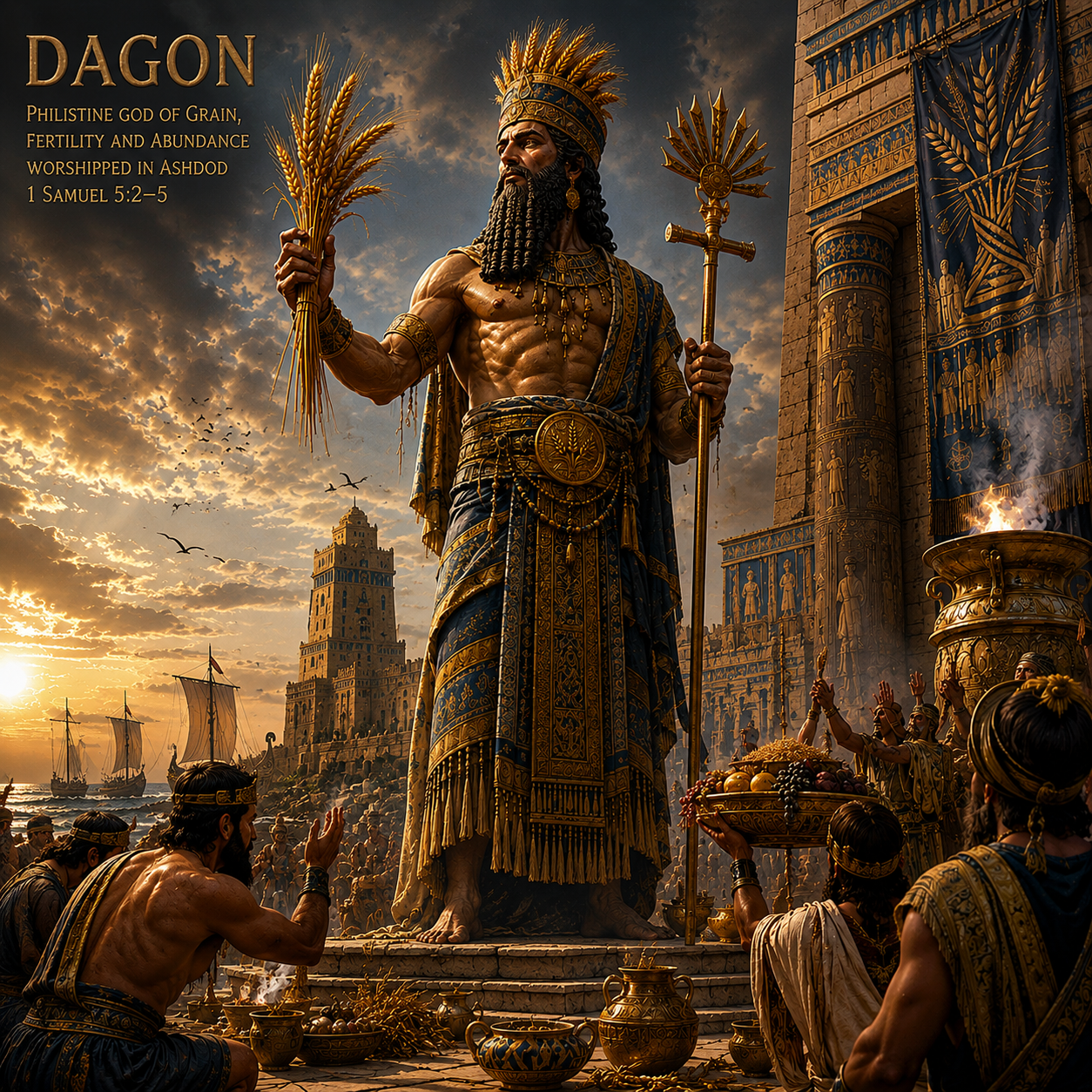
The Problem With Dagon
If you have sat in a church for any length of time and heard a sermon on the Philistines, you have almost certainly been told that Dagon was a fish god. Half man, half fish — a grotesque sea creature worshipped by Israel’s great enemies. It is a vivid image. It makes the Philistines seem primitive and the story of the Ark in Dagon’s temple even more dramatic.
The problem is that it is almost certainly wrong.
Dagon is one of the most difficult gods of the ancient Near East to study precisely because the popular image of him has almost no archaeological support. The fish-man depiction comes from a misreading of his name — the Hebrew word dāg means small fish — combined with later medieval artistic traditions and the fact that the Philistines were a sea-faring people. It became a story that felt right. It spread. It is still being preached today.
The historical claims regarding Dagon’s true nature as an agricultural patriarch — rather than a fish god — are pieced together from thousands of Bronze Age clay tablets discovered across Syria and Mesopotamia. What they reveal is a god far older, far more powerful, and far more theologically interesting than the fish-man of Sunday school.
What the Ancient Sources Actually Say
1. The Ebla Tablets (c. 2300 BC)
Discovered at Tell Mardikh in modern-day Syria, the Ebla tablets are among the earliest written records of Dagan’s cult. At Ebla, from at least 2300 BC, Dagan was the undisputed head of a city pantheon that included some 200 deities.
He bore the titles BE-DINGIR-DINGIR — ‘Lord God of gods’ — and Bekalam, ‘Lord of the Land.’ He was also called ti-lu ma-tim, ‘dew of the land,’ and Be-ka-na-na, possibly ‘Lord of Canaan.’ One entire quarter of Ebla and one of its city gates were named after him.
— New World Encyclopedia — Dagon
This is not a fish god. This is a supreme patriarch — the lord of the land itself, the god who makes the earth produce. An entire city named a neighborhood and a gate after him. His consort was called simply Belatu — “The Lady.” They were worshipped together in a temple complex called E-Mul, the “House of the Star.”
Source: New World Encyclopedia — Dagon | newworldencyclopedia.org/entry/Dagon
2. The Mari Archive & Royal Inscriptions (c. 2300 – 1800 BC)
Over 20,000 cuneiform tablets were recovered from the royal palace of Mari on the Euphrates in modern-day Syria. They are one of the richest archives of Bronze Age political and religious life ever discovered. Dagan appears throughout them — not as a sea creature but as a god of land, empire, and royal legitimacy.
The great Akkadian conqueror Sargon of Akkad — who built the world’s first empire around 2300 BC — left an inscription stating that Dagan gave him the Upper Land after Sargon prayed to him at the city of Tuttul. His grandson Naram-Sin recorded similar:
“Naram-Sin slew Arman and Ibla with the ‘weapon’ of the god Dagan who aggrandizes his kingdom.”
— Ancient Near Eastern Texts (ANET), p. 268
Later, a governor’s letter to King Zimri-Lim of Mari describes a prophetic dream in which Dagan appears to a man as a living human person to give political commands — behaving entirely like a human monarch, not a sea creature. Dagan speaks, gives orders, threatens consequences. He is understood as a powerful, rational, authoritative father figure. Not a beast.
King Hammurabi himself — author of the most famous law code of the ancient world — invokes Dagan in his famous preface:
“The subduer of the settlements along the Euphrates with the help of Dagan, his creator.”
— Hammurabi Law Code Preface — ANET
Source: New World Encyclopedia | ANET p. 268, 623
3. The Ugaritic Texts / The Baal Cycle (c. 13th–12th Century BC)
The tablets discovered at Ras Shamra on the coast of Syria — ancient Ugarit — are the richest single source for Canaanite mythology and the most important background material for understanding the religious world of the Old Testament.
In the Ugaritic Baal Cycle, the storm god Baal is repeatedly referred to by a single epithet: bn dgn — “the Son of Dagon.” Dagon is the patriarch. Baal is his heir. In Northwest Semitic pantheons, the fathers of the gods were universally depicted as dignified, bearded, fully human patriarchs — not fish creatures. At Ugarit around 1300 BC, Dagon had a large temple and was listed third in the entire pantheon, following only the father-god and El.
The Phoenician writer Sanchuniathon — drawing on traditions going back to at least 1200 BC — translated Dagon’s name into Greek as Siton, meaning grain, and explained: “Dagon, after he discovered grain and the plough, was called Zeus Arotrios” — Zeus the Ploughman. The god who taught humanity to farm. The god who gave them bread.
Source: New World Encyclopedia — Dagon | Ugaritic texts via gotquestions.org
Where He Was Worshipped — The Geography
Dagan’s geographic reach across two thousand years of worship tells its own story.
Mari, Syria (c. 2500 BC) — His Oldest Home
The earliest known references to Dagan place him at Mari on the Euphrates — a major Bronze Age trading hub. He was already a supreme deity here. His worship then spread in every direction across the ancient Near East over the next fifteen hundred years.
Ebla, Syria (c. 2300 BC) — Head of 200 Gods
At Ebla — one of the most powerful city-states of the Bronze Age, with a population estimated at 30,000 — Dagan held the highest position in a pantheon of two hundred gods. The city organized itself around his worship. A gate. A quarter. A great temple complex.
Tuttul & the Euphrates Valley (c. 2000 BC)
Sargon prayed to Dagan at Tuttul before his imperial campaigns. The city was one of Dagan’s primary sacred sites — a pilgrimage destination for kings seeking divine legitimacy for conquest.
Ugarit, Coastal Syria (c. 1300 BC) — Father of Baal
At this great coastal city Dagan held a major temple and occupied the third position in the pantheon. The Baal Cycle, composed here, establishes him permanently as the patriarch of the Canaanite divine family.
Philistia — Gaza, Ashdod, Beth-Shean (c. 1200 – 1000 BC)
By the time Dagan appears in the pages of the Old Testament, his worship has moved west into Philistine territory. He is now the chief deity of Israel’s most persistent enemy — the god in whose name the Philistines fight, in whose temples they celebrate their victories, in whose honor they display the heads and armor of defeated Israelite kings.
It is here, at the western edge of his long history, that the God of Israel meets him face to face.
Every Place Dagon Is Named in Scripture
Dagon is named explicitly in four passages of the Old Testament. Each one is worth reading in full.
Judges 16:23–30 — Samson and the Temple of Gaza
Judges 16:23–24 “Now the lords of the Philistines gathered to offer a great sacrifice to Dagon their god and to rejoice, and they said, ‘Our god has given Samson our enemy into our hand.’ And when the people saw him, they praised their god. For they said, ‘Our god has given our enemy into our hand, the ravager of our country, who has killed many of us.’”
Judges 16:28–30 “Then Samson called to the LORD and said, ‘O Lord GOD, please remember me and please strengthen me only this once, O God, that I may be avenged on the Philistines for my two eyes.’ And Samson grasped the two middle pillars on which the house rested, and he leaned his weight against them, his right hand on the one and his left hand on the other. And Samson said, ‘Let me die with the Philistines.’ Then he bowed with all his strength, and the house fell upon the lords and upon all the people who were in it. So the dead whom he killed at his death were more than those whom he had killed during his life.”
The Philistines had brought Samson — blinded, enslaved — into the temple of Dagon as a living trophy of their god’s power. Three thousand men and women on the roof celebrating. Dagon had defeated Israel’s champion. Or so they believed.
One prayer. One moment of renewed strength. The two central pillars come down and the entire temple collapses. More Philistines die in that single moment than Samson killed in his entire lifetime. The god of provision cannot protect his own house.
1 Samuel 5:1–7 — The Ark Before Dagon in Ashdod
1 Samuel 5:2–4 “Then the Philistines took the ark of God and brought it into the house of Dagon and set it up beside Dagon. And when the people of Ashdod rose early the next day, behold, Dagon had fallen face downward on the ground before the ark of the LORD. So they took Dagon and put him back in his place. But when they rose early on the next morning, behold, Dagon had fallen face downward on the ground before the ark of the LORD, and the head of Dagon and both his hands were lying cut off on the threshold. Only the trunk of Dagon was left to him.”
This passage is one of the most deliberately humiliating scenes in all of Scripture. The Philistines have captured the Ark — the most sacred object in Israel, the throne of the invisible God — and placed it in Dagon’s temple as a war trophy. The message: our god defeated your God.
The next morning Dagon is face-down on the ground before the Ark, as if in worship. They stand him back up. The morning after, he has fallen again — and this time his head and both hands have been severed and left on the threshold. He is a stump.
Head and hands in the ancient Near East signified precisely what they signify today — authority and agency. The lord of grain, the king of gods, the god who gave empires to Sargon and Hammurabi, is left without a head to think with or hands to act with. He cannot even fall in the direction he chooses.
1 Chronicles 10:10 — Saul’s Head in the Temple
1 Chronicles 10:10 “They put his armor in the temple of their gods and fastened his head in the temple of Dagon.”
After Saul’s death on Mount Gilboa, the Philistines display his severed head in Dagon’s temple as a victory offering. The king of Israel, credited to the power of their god. Within one generation, David has broken Philistine power permanently. The god they thanked for their greatest victory cannot hold the territory he supposedly gave them.
Joshua 19:27 — A Town Named Beth-Dagon
Joshua 19:27 “…it goes to Beth-dagon, and touches Zebulun and the Valley of Iphtahel northward to Beth-emek and Neiel…”
A passing geographic reference — but a significant one. A town in the territory allotted to the tribe of Asher is called Beth-Dagon — “House of Dagon.” His worship was already present in the land before Israel fully settled it. The god of grain had deep roots in Canaan long before the Philistines arrived.
Where the Fish-God Story Came From
This is worth a careful note because it is an example of how false ideas about God — and false gods — can spread and become received wisdom even inside the church.
The fish-god tradition for Dagon appears to stem from three sources working together:
1. A linguistic accident. The Hebrew word dāg means fish. Dagon’s name contains those letters. Medieval Jewish commentators — including Rabbi David Kimhi in the 13th century — made the connection and suggested Dagon was half man, half fish. The etymology was almost certainly wrong, but the image was vivid.
2. The Sea Peoples connection. The Philistines were a maritime people who came from the Aegean. It was reasonable to assume their chief god had something to do with the sea. The association felt logical even without evidence.
3. Later artistic traditions. Once the fish-man image entered medieval religious art, it self-reinforced. Paintings, woodcuts, engravings — all depicting Dagon as a merman. By the time these images reached modern popular Christianity, they had centuries of artistic tradition behind them. They looked authoritative.
No definitive iconography of Dagon as a fish-god has been found. The merman depiction may stem from later artistic traditions rather than contemporary evidence.
— Penn Museum / Jeffrey P. Emanuel research on Philistine material culture
This matters not only as a historical correction but as a theological lesson: we can inherit false images of the enemies of God just as easily as we can inherit false images of God himself. The fish-man Dagon is easier to mock than the actual Dagon — the ancient, powerful, widely worshipped lord of grain and land and patriarchal authority who tempted Israel for centuries. The real Dagon was a far more serious spiritual competitor than a fish.
The God Above Gods — A Universal Human Instinct
Here is the observation that opens the door to everything else in this study.
Dagon, at the peak of his worship in the third millennium BC, held the title BE-DINGIR-DINGIR — Lord God of gods. Not a god. Not one god among many equal gods. The god above the gods. The patriarch of the entire divine order. The one from whom the other gods derived their authority.
This title was not unique to Dagon. Across the ancient Near East, across every major polytheistic tradition, you find the same instinct: there must be one above all the others. A father of the gods. A king of the divine council. El at Ugarit. Anu in Sumeria. Atum in Egypt. Zeus among the Greeks. Odin among the Norse. The name changes. The structure never does.
How did human beings — separated by thousands of miles, by language, by culture, by centuries — all arrive at the same conclusion? That the divine order must have a head. That there must be a god above the gods. A king of kings.
One answer, which does not require you to believe anything: it is a universal feature of human social organization projected onto the cosmos. Humans have hierarchies. They imagined the divine realm must also have one.
Another answer, which requires you to take Scripture seriously: it is a suppressed memory. Paul writes in Romans 1 that what can be known about God is plain to all people — that God has made it evident, that His eternal power and divine nature have been clearly perceived in the things that have been made. The nations who did not know Yahweh still knew, somehow, that there was a God above gods. They took that knowledge and gave it the wrong name. They pointed the throne at Dagan, or El, or Zeus. But they kept pointing at a throne.
The Israelites would give that position the right name: YHWH. Yahweh. The LORD. Not one god among many but the only God — and the one all those tilted thrones had always been pointing at without knowing it.
The idea of a King of Kings is very old. Older than Israel. It is embedded in the deepest layer of human religious instinct. When the New Testament calls Jesus the King of Kings and Lord of Lords, it is not inventing a new concept. It is answering the question that Dagon, El, Anu, and Zeus were all imperfectly asking.
“For although they knew God, they did not honor him as God or give thanks to him, but they became futile in their thinking, and their foolish hearts were darkened. Claiming to be wise, they became fools, and exchanged the glory of the immortal God for images resembling mortal man and birds and animals and creeping things.”
— Romans 1:21–23
Dagan was not a fish. He was a bearded patriarch, lord of grain, father of gods, giver of empires. And he was a substitution — a placeholder in the god-above-gods position that was always meant to be filled by One who actually created the grain, actually owned the land, actually held the authority of which every human king and every ancient deity was only an imperfect shadow.
What Dagon Teaches Us
Dagon promised provision. He promised that the land would produce, that the harvest would come, that the empire would hold. He promised that if you honored him with the first grain, the first trophy, the head of your defeated enemy — he would make you secure.
And people gave him everything for that promise. For two thousand years.
The God of Israel met him three times in Scripture. In Gaza, Dagon’s temple collapses. In Ashdod, Dagon falls face-down twice and loses his head and hands. In Beth-Shean, the empire that displayed Saul’s head in his temple is broken within a generation.
The pattern is always the same. The false god makes the promise. The false god takes the offering. The false god cannot deliver. And the living God, patient and unhurried, demonstrates the difference — not with argument but with reality.
The question Dagon puts to every generation is not theological. It is practical. What are you trusting to provide for you? What gets the first grain of your harvest — the first hour of your morning, the first portion of your income, the first loyalty of your heart? And when that thing fails to deliver the security it promised, what will you do?
The answer the Old Testament keeps giving, through every defeat of every false god, is the same:
“I am the LORD your God, who brought you out of the land of Egypt, out of the house of slavery. You shall have no other gods before me.”
— Exodus 20:2–3
PRIMARY SOURCES & FURTHER STUDY
New World Encyclopedia — Dagon | newworldencyclopedia.org/entry/Dagon
Ancient Near Eastern Texts (ANET) — Pritchard, ed. | Princeton University Press
Jeffrey P. Emanuel — Digging for Dagon | Harvard / Society of Biblical Literature, 2011
Penn Museum Journal — The Temples of Dagon and Ashtoreth at Beth-Shan | 1926
Journal of Ancient Near Eastern Religions — Dagon Our God: Iron I Philistine Cult | 2016
Scripture: Judges 16:23–30 · 1 Samuel 5:1–7 · 1 Chronicles 10:10 · Joshua 19:27 · Romans 1:18–23
Leave a Reply