
Brand Study: Apple
Observed through a seven-section, descriptive framework
1. Why This Brand Is Worth Studying
Apple is worth studying because it became one of the most influential consumer brands in history without competing primarily on price, specifications, or speed to market. Its success reshaped how consumers evaluate technology products and how companies think about design, integration, and brand meaning.
For small businesses, Apple is useful not as a model to copy, but as a case that shows how coherence and repeated experience can shape identity over time.
2. The Environment It Entered

Apple entered consumer technology markets that were already crowded and largely specification-driven. Personal computers were positioned around processing power and compatibility. Mobile phones prioritized buttons, carrier features, and incremental hardware improvements.
Consumer expectations were low around ease of use. Complexity was accepted as the cost of functionality. Design was secondary to engineering, and ecosystems were fragmented.
This environment created an opportunity for differentiation, but not an obvious one. Many companies had access to similar components and technologies.
3. What the Brand Did First
Apple’s early moves in its most successful eras were not about breadth, but about reframing existing categories.
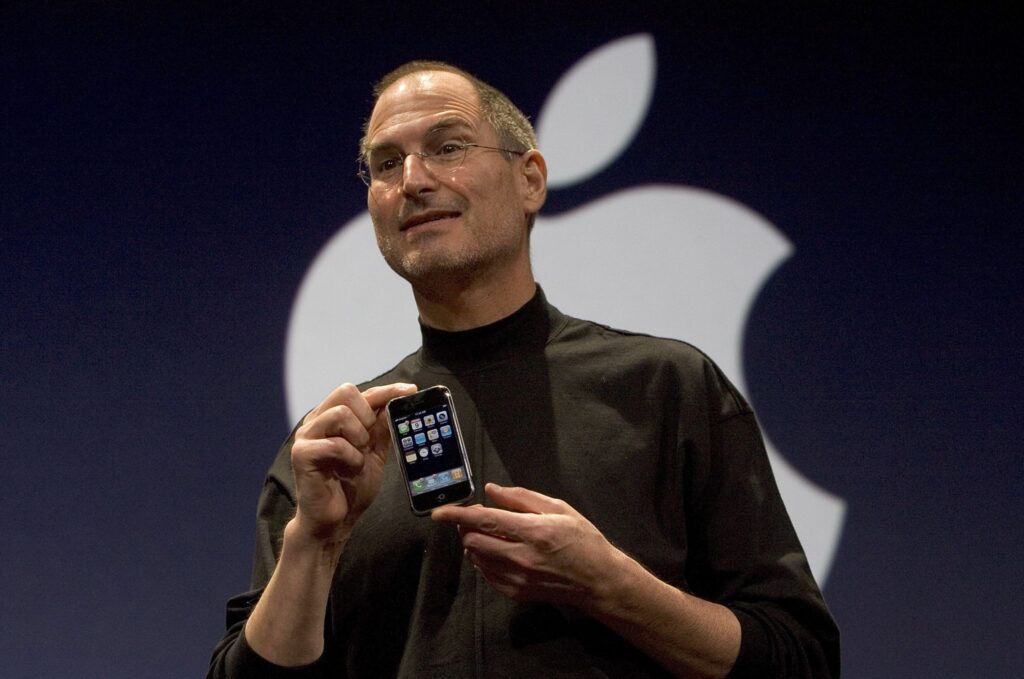
With personal computers, Apple emphasized interface and usability rather than raw power. With the iPod, it paired hardware with software and content distribution. With the iPhone, it replaced the physical interface of phones with a software-first interaction model.
These were not new categories. Apple entered established markets with products that behaved differently.
4. What Actually Drove Early Traction

Apple’s early traction in each category came from immediate experiential differences rather than abstract claims.
Users did not need to understand how the products worked internally. The benefits were felt directly:
- devices were easier to use
- interactions were more intuitive
- products felt complete rather than modular
Marketing helped create awareness, but adoption was driven by word-of-mouth and firsthand experience. Once users interacted with the products, competing alternatives felt cumbersome by comparison.
5. How the Brand’s Identity Took Shape
Over time, Apple’s identity emerged through repetition. Across products and years, certain patterns became consistent:
- emphasis on simplicity
- control over hardware and software together
- visual and physical restraint
- avoidance of unnecessary customization
These patterns formed expectations. Consumers began to associate Apple with tools that “just work,” even when that came with tradeoffs such as higher cost or reduced flexibility.
Apple did not define this identity explicitly at first. It became visible through accumulated use.
6. How the Brand Grew

Apple’s growth has been marked by selective expansion. The company avoided releasing large numbers of product variants and limited its lineup intentionally.
Growth came through:
- extending existing product lines rather than launching unrelated ones
- building an ecosystem that increased switching costs
- using retail spaces to control experience and education
Apple also chose not to compete in many segments it could have entered, such as low-cost hardware or highly modular systems. These decisions reinforced brand clarity but narrowed the addressable market.
7. Practical Reflections for Small Businesses
Apple’s case offers several observations that small businesses can think through, without assuming the same outcomes are possible.
- Apple benefited from controlling the full user experience, which may not be feasible for smaller firms, but clarity of experience often is.
- The company’s identity emerged from repeated product behavior, not branding statements. Small businesses can observe how their own customers describe them and use that as a guide.
- Apple did not try to serve every customer. Small operators often face similar tradeoffs and can learn from the discipline of saying no.
- Marketing amplified Apple’s strengths, but did not replace them. For small businesses, this reinforces the importance of aligning messaging with actual delivery.
Apple’s trajectory shows that brand identity can form gradually through consistent execution. The lesson is not that simplicity always wins, but that coherence over time creates meaning, even in competitive markets.
Leave a Reply